Week 4 Reflection | Strategies of Freedom

Week 4 


As in previous weeks I have found this weeks tasks difficult but rewarding. Initially I had the guilt of feeling that I wasn’t doing enough or being disorganised due to putting too much emphasis on last weeks zine task and fiddling about with InDesign.

Throughout the module I have been mindful of broadening my contextual understanding and trying to engage with the research of at least two practitioners a week, commenting on them in accordance with the weeks theme, this week being strategies of freedom. 

In order to understand and effectively respond to the tasks it was necessarry to generate an understanding of photographic freedom in order to navigate an effective response which encompasses my project. The starting point for an understanding was one of context. In terms of my own project, this was initially the decision of using digital or analogue techniques however I then begun to contemplate the question of identifying strategies of freedom in a hypereality. Flusser (2000) reminds us that…

‘life is coming to mean feeding apparatus and being fed by them… The task of the philosophy of phoography, is to question photographers about freedom. To probe their practice in the persuit of freedom.’

Here Flusser poses a useful question which one may consider beyond the basic concepts of image, apparatus, programme and information as he earlier argues. As a result I continued to look deeper at the work of Jenny Odell this week focussing on her projects ‘Satellite Landscapes’ (2015) and ‘Travel by Approximation: A Virtual Road Trip’ (2010). 

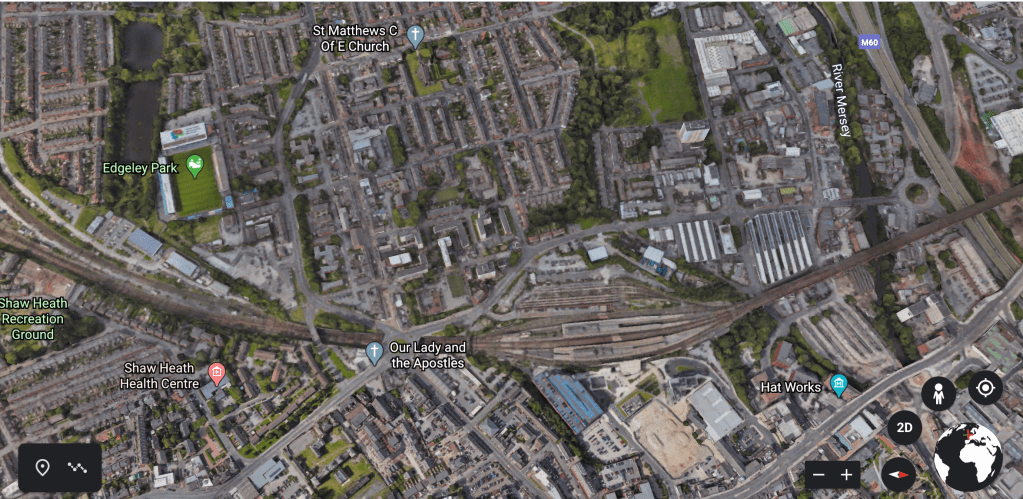
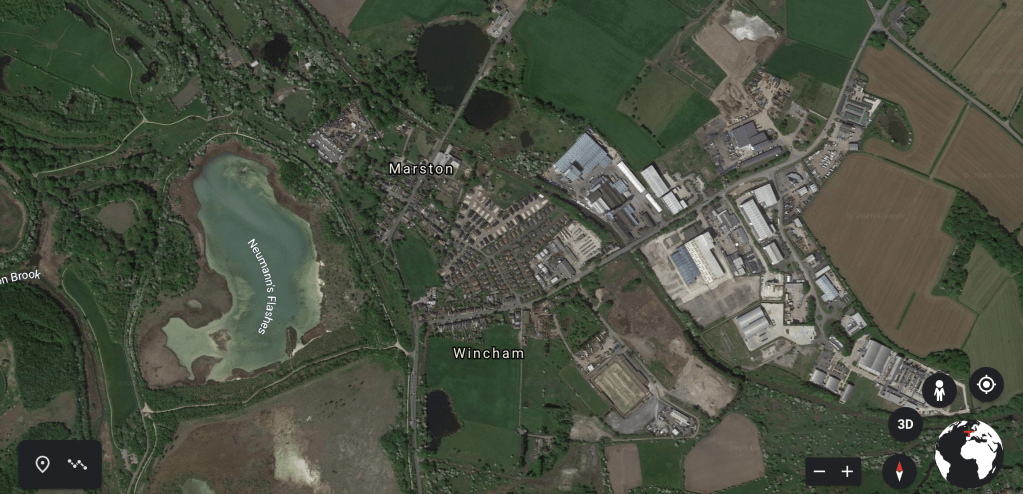
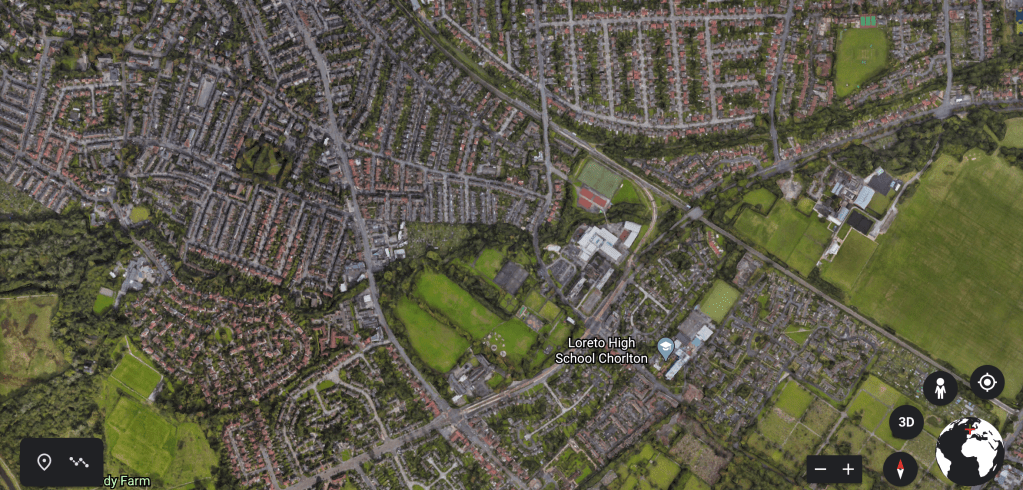
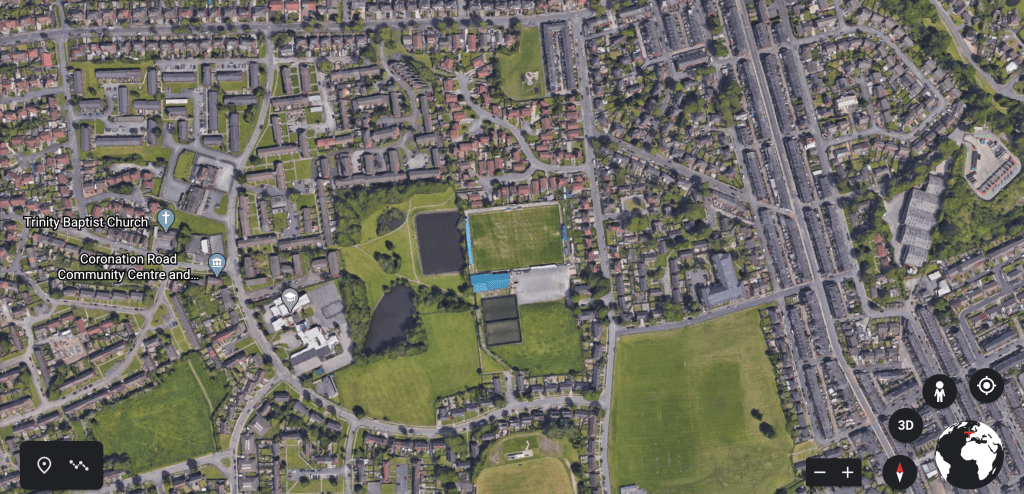
In relation to Satalite Landscapes I was interested in Odell’s ideas about distance and the lack of visual traces as a critisism of satellite photography.  In order to explore this approach I used Google Earth to observe some of the football pitches that I have visited throughout my football project. I did find this interesting to an extent however having identified 5 images, the repetition of vantage points, I felt diluted the impact and subsequent interest in them. Threefore I am inclined to agree with Odell in her assertion. Although the images were interesting.

Screenshot of East Manchester

Going forward with such tasks, due consideration will be required about the presentation of images. Disseminated as a collection of similar images I feel an audience would be subject to an overload of information. However as a stand alone piece or part of a sequence. The images may work more effectively. A juxtaposition of distance when coupled with some of my documentary work a possible strategy. I will experiment with this type of sequencing when this post is concluded.

As a result of these observations I decided to further my engagement throughout the task of making work relevant to my project by making a short video using google street view. NavigatING my way through the streets of Manchester. The starting point being an area of South Manchester where the old Manchester City stadium once stood to an area of East Manchester where the new stadium is. The inspiration for doing this was the Odell project, ‘Travel by Approximation’ where Odell makes a virtual road trip using google street view and trip advisor amongst other sources in order to find accommodation, eat and fill her car with petrol.

Andrew Findlay: Strategies of Freedom Video

In terms of the use of sound, I took influence the Chatonsky project, Vertigo at Home. Here Chatonsky used the score from the 1958 Hitchcock film ‘Vertigo’. For the video I chose to use a piano version of the Stone Roses ‘I am the Resurrection’. The Stone Roses are an important piece of Manchesters cultural history and I felt the theme of the song met with the narrative of Manchester City  leaving their old stadium and creating a new history for themselves. 
The final photographer of interest this week is Robert Overweg and his 2010 project ’Shot by Robert’. Overweg describes himself as ‘a photographer in virtual world environments’. His project focuses on glitches in computer games such as Grand Theft auto. He seeks and isolates scenes highlighting the disjuncture within them. Commenting on his work Overweg states…

 ‘I proceed to the outskirts of the virtual world which I dissects through my photography. In doing so, I draw your attention to environments that are often overlooked and yet ironically appear eerily familiar.’ 

in doing this Overweg is operating in a hyperreality with the intention of highlighting indescrepencies within specific contexts such as Gran Theft Auto. I see this as a type of activism against digital innovation insofar as the digital realm is often responsible for the dissemination of photographs of human inperfections, Overweg is choosing to disseminate images of digigital insecurities. In suggesting this I am not arguing for the existance of a digital conscious. Maybe aimed at game developers or gatekeepers of mass market digital products. 

The digital world that Overweg challenges is relevant to my project in this case the Electronic Arts game franchise Fifa.
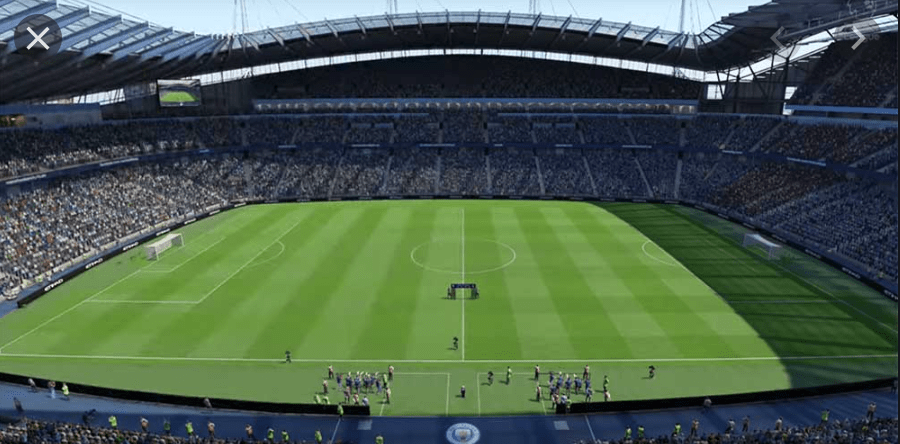
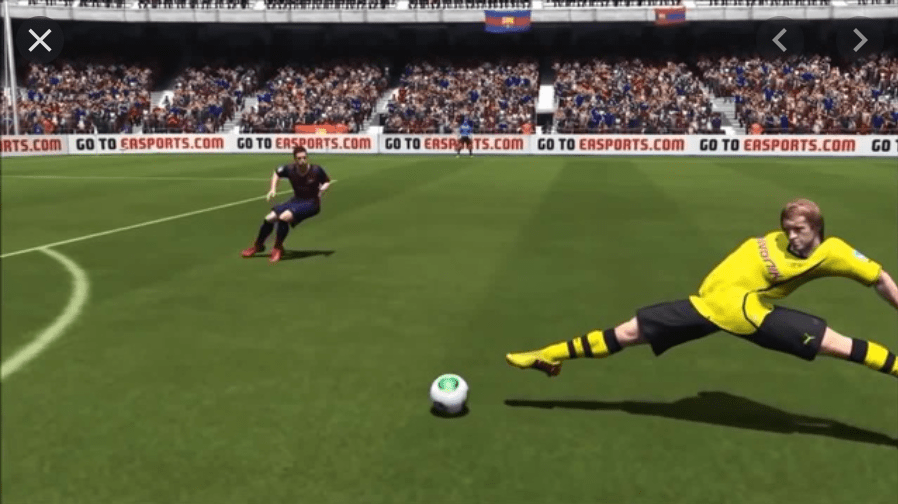
Screenshot from Fifa 2020
Screenshot taken from Fifa 2020

Flusser, V. (2000) Towards a Philosophy of Photography. Reaktion Books, London.

Chatonsky, G. (2015) Vertigo@Home [Online] Available at: http://chatonsky.net/vertigo/  (Accessed 26th June 2020)


Odell, J. (2010) Travel by Approximation: A Virtual Road Trip [Online] Available at: http://www.jennyodell.com/tba.html (Accessed 26th June 2020)


Odell, J. (2015) Satellite Landscapes [online] Available at: http://www.jennyodell.com/satellite-landscapes-book.html (Links to an external site.) (Accessed 23 June 2020)

Overweg, R. (2010) Shot by Robert [Online] Available at: https://www.robertoverweg.com/Shot-by-Robert
(Accessed 26th June)

Week 4 | Forum Posts

Post 1: Week 4 Forum

The example I have chosen is the Satellite Landscapes project by Jenny Odell. Currently reading her book ‘Hot to do Nothing’ which is a type of critique of the attention economy created by social media. The Satellite Landscapes project as Odell (2015)  suggests is ‘ a place whose existence feels peripheral to immediate experience, geographically, psychologically, or both’. Her ideas often comment on the way that technology has a power to create distance between people and human experience highlighting that as technology develops the impact is to remove more and more of the humanity between people. I really identify with her intentions and consider her work to be unusual while forward thinking and intelligent.

Post 2: Week 4 Activity

Continuing the theme I spoke of in the first task of this week in relation to the Jenny Odell’s 2015 project, ‘Satellite Landscapes’. Odell suggests ‘The peripheral nature of satellite landscapes, then, has as much to do with repression as it does with distance, the hiding of visual traces, or habituation.’ What most intrigues is the idea of ‘habituation’ as it was a word I was unfamiliar  with. I often find myself faced with new terminology and feel that developing a language to speak about photography is important as a personal goal.

I used Google Earth to explore the surrounding areas and communities of the football grounds I have visited. I felt that the images may be interesting and provide visual clues regarding the infrastructure of these places. Saying something about their importance, their local industries etc.  However by the time I had found the 5th image, the landscapes started to become familiar and slightly banal. 

In considering the idea of ‘photographic freedom’ Flusser (2000) comments ‘Freedom is the strategy of making chance and necessity subordinate to human intention, freedom is playing against the camera’.  In this sense, I consider this a central theme to the Jenny Odell projects I have researched such as Satellite Landscapes. In making work such as this, the impact of the work in a conventional sense isn’t the main concern. I feel that the use of google earth in this context represents a piece of activism as it highlights a technology we all have access to but wouldn’t think of using to include in a creative project.

Flusser, V. (2000) Towards a Philosophy of Photography. Reaktion Books, London.

Odell, J. (2015) Satellite Landscapes [online] Available at: http://www.jennyodell.com/satellite-landscapes-book.html (Links to an external site.) (Accessed 23 June 2020)

Week 4 | Zine Task

I do have some basic knowledge of InDesign in terms of placing text and images however I really struggled with using the layers to format text, block colours and images. I invested some time in attempting to work with the alpha channels to achieve a text wrap effect however when I did this I couldn’t decide on a style that I was happy with. The task did reinforce some existing knowledge but when being ambitious with such projects, solving one problem opens up a raft of other issues. As a result, I hit the point where I needed to accept defeat and move on with other tasks.

https://indd.adobe.com/view/07cffe52-e097-49ee-ab9f-fcf86a356bfa

Jenny Odell | How to Do Nothing

Throughout my project I have been interested in my non commercial football project as being activist in its nature. A comment against the digital consumption of football. In order to understand my objective in a broader sense my research had led to the consideration of the digital economy as opposed to an experience led economy. By this I don’t mean to suggest that all experiences are non commercial however my reflection upon reading some of this book lead to an idea of the higher echelons of the football such as stadiums may be comparable to theme parks. Where experiences are researched and manipulated to provide maximum efficiency or productivity. Stadiums are designed with excellent facilities to eat, drink, read and purchase the latest range of leisurewear as opposed to the spaces that I inhabit, where the emphasis is ‘watching the game’. Whether that be in a local park or local stadium. Odell (2019, p14) states…

‘In a public space, ideally you are a citizen with agency; in a faux public space, ideally, you are either a consumer or a threat to the design of the place.’

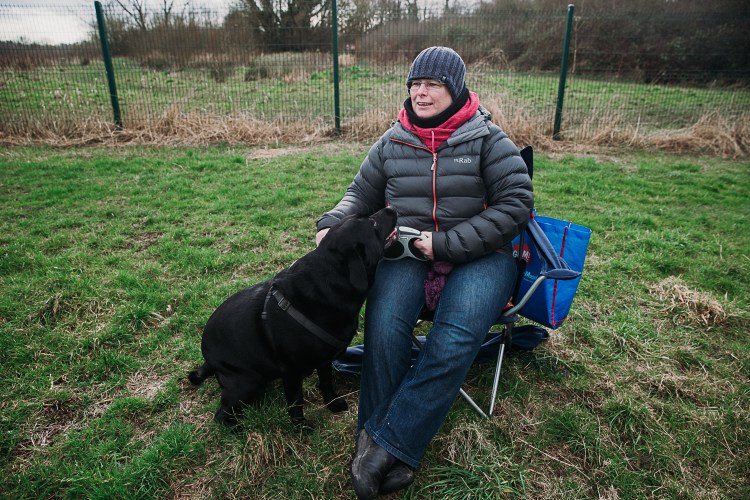
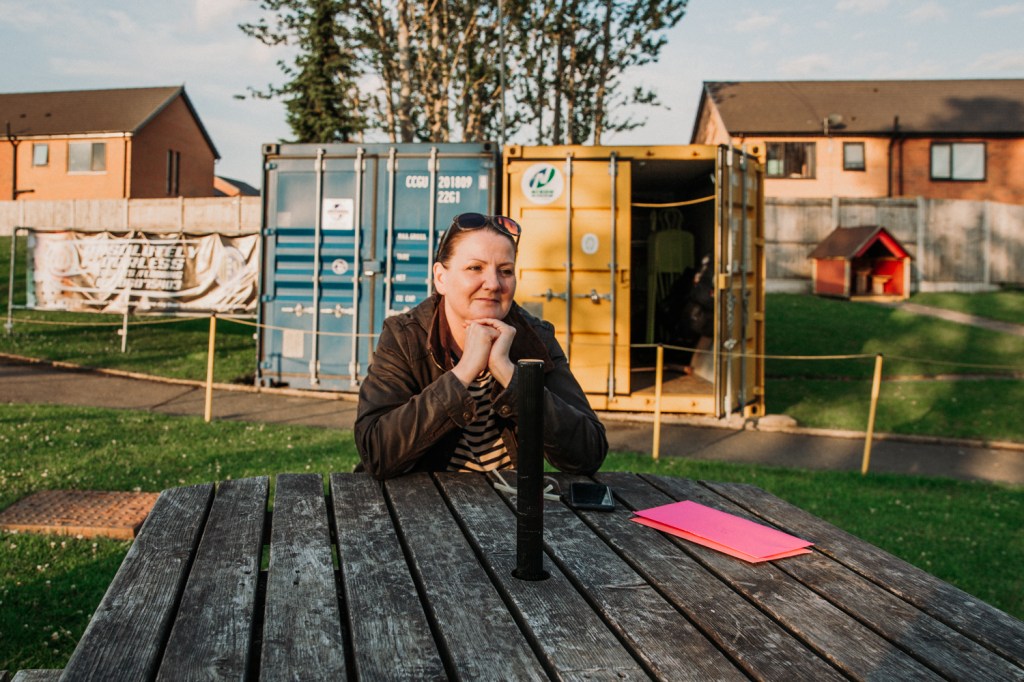
It is not my intention to argue that all non league football spaces are comparable to public spaces. In fact they are quite the opposite. Usually having to pay to enter in addition to being able to purchase a number goods. The spaces inhabited by people within this world could neither be considered as a ‘faux public space’. From my experience, spectators may attend for a number of reasons. As fans, a centre for the community or somewhere to be alone and collect ones thoughts. As previously stated/illustrated in the last module, figure 1 represents an example of consumption on ones own terms. Entering the space to be alone and watch the spectacle take place, without being seen as a consumer or a rule breaker for arriving with her own seat and supplies.

Figure 1: Drew Findlay

Odell (2919, p13) continues her argument regarding public spaces in a way that may be illustrative of the example I have used when she states

‘True public spaces, the most obvious examples being parks and libraries, are places for – and thus the spatial underpinnings of – ‘what we will.’ A public, non commercial space demands nothing for you to enter, nor for you to stay; the most obvious difference between public space and other spaces is that you don’t have to buy anything, or pretend to want to buy something to be there

Although not usually free space to watch football. The non league part of the game represents fairness. Usually under £10 for an adult with concessions usually under £5.

Odell (2019, p15) ‘just as we lose noncommercial spaces, we also see all of our actions as potentially commercial’

I understand that the ideas expressed above appear to be far away from a photography project. The ideas of Odell are relevant in establishing the theme and justification of my project and the activist roots that I use to underpin my argument. Such ideas may be useful going forward as a broad message to communicate the intent of this project. The intent may fuel the potential to produce metaphorical or work of a poetic nature.

Week 3 Reflection | collaboration

I have found the theme of working with others very useful but quite difficult to engage with as my approach to this course is very much an individual journey. When considering the ideas of Azouulay (2016) who states “The photographic event’s degree zero”. In relation to collaboration. I disagreed to some extent as I felt that the practicioner’s intent wasn’t recognised within this sense. I understand that intent usually isnt a collaborative process however in preparing for a project or a study, one is required to to build a framework for collaboration to happen. It is my argument that this stage of pre collaboration needs to be recognised and highlighted. 

In terms of collaboration on the weekly forums, I had a useful discussion with a fellow student. It was interesting to share our methodologies. As reslt I felt that my work project work was quite basic and provoked further reflection of the non league football project I am undertaking as I am currently colaborating with a local junior football club. I have used this space to apply knowledge of feedback I received from Michelle regarding my approach to portrait photography. I feel the I am improving in this area but at present I am struggling to find the connection between the work I am creating at the moment with the work I have created in the previous modules. I feel further research is required in this area. I previously researched Julian Germain ’Football in Wonderland’ which has a disjointed narrative contained within the broader context of football. I will look closer at this text in order to develop the philosophical reasons for my project. Lockdown has ensured the fandom element of my work to come to a standstill. At the same time it has provided an opportunity to consider different perspectives of the broader theme of football and the noncommercial part of the game. 

My current reading is in the direction of philosophical approaches that oppose progressive technology and the idea of technology replacing the idea of ‘being there’. The lived experience and interaction with people, places and objects. This I am finding is useful with regard to my previous justification of the project as a piece of activism. I always felt that the subjects encompassed within my work are reacting against the modern cmmercialised game. The people who choose to consume the lived experience as opposed to the digital experience of TV, social media and the attention economy of opinions based on other opinions without ever being there. 

All things considered at this time. I feel that I need to cultivate the philosophical reasoning for my project with a positive message in mind. Most football fans consume the game in digital format in one shape or another. Attacking this as a form of activism through my project would be cynical and counterproductive. Therefore I feel it is important to have a positive message of which I feel the idea of ‘being there’ will encompass the celebration of physical experience and humanity. Further research needed to cultivate.

Week 3 Forum | Collaboration or Participation?

Within my project of non league football spectatorship I am required to work in a collaborative process on various levels. Firstly, having identified the event of a football match I would like to attend in order to photograph. The collaborative process is initiated by myself, making contact with relevant club officials using email or social media. 

At this stage I am usually met with enthusiasm. I describe the nature of my project and what I am trying to achieve. This is a useful method and a form of preparation in a personal sense. I select football matches based on a range of factors including: the local fixture list and my personal knowledge or secondary research of the stadium in order to understand the type of aesthetic I will be working with. With this in mind I feel the assertion of Azouulay (2016) when she states in relation to collaboration “The photographic event’s degree zero”. I consider unstable. Based on the assumption that degree zero is the photographic event. The statement does not recognise the planning or research stage of the photographer. I consider this to be relevant because every project must start with some type of intention. Whether taking a camera to a tourist destination, describing life or documenting inequality. The photographer must start with some type of intent, which in a personal sense precedes the photographic event. I agree with the idea that without collaboration there is no project or study however I believe that intent in whatever form should be recognised. Based on the assumption that a ‘degree zero’ represents a type of neutrality I refer back to the intent of the photographer. Chalfen (2011) makes the distinction ‘between’ projects and ‘studies’. a project initiated by a caring individual within a context may be an act of responsibility or personal interest. These ideas, however noble, may be compromised by intentional or unintentional bias. With respect to my football project, my intention was and is to explore, however I am aware of my personal bias. The people of this world gave me a lot and I learned many lessons which have stuck with me. The football gave me much less, such as broken bones and confidence issues. In reflecting on this, I realise that my project is a type of metaphor for how I feel about this world. It gave me a lot, but took away other things. Therefore my selection of a project is not objective. 

With regards to the people I collaborate with, I have already discussed above such as club officials and gatekeepers of such clubs. The second stage of collaboration when I attend a football match is the interaction with individuals that I encounter. The difficulty in this cannot be overstated, I approach tens of people, I speak and listen to their stories before taking their photograph. This is the result of watching and observing my surroundings before approaching people. Although on occasion, an individual will be known to me. Most of them are unknown to to myself. I often find myself having to earn some trust before lifting the camera. In this sense I am required to earn each photograph that I take, when I take a portrait or lift the camera when people are aware of my presence. the photographic event maybe ground zero for the collaborator such as the person in front of the lens, but it is not for the photographer. 

In terms of perspective and voice of the subjects I photograph, they are often limited to what I communicate with them regarding my intentions. If my explanation is sufficient and I am successful at this stage, a person of interest makes the transition to collaborator. This consent cannot be underestimated, maybe seen as a type of submission. A submission to be objectified in a way led by my intention. Sontag (1979, p.14) states, “To photograph people is to violate them, by seeing them as they never see themselves, by having knowledge of them they can never have; it turns people into objects that can be symbolically possessed”. Sontag’s ideas are particularly relevant to the collaborations and subjects that I work with. To consent to being seen as they never see themselves or ‘having a knowledge that they will never have’ infers not just a collaboration, but a power relationship where the person with the mechanical instrument is dominant, the subject subordinate. To achieve this, with reference to my project, a subject needs to believe in my intention, trust my motive. The return for the collaboration is to be part of the intention of a noble project. A form of activism supporting participation as opposed to digital consumption. 

The people who appear in my project are hugely important to my project. They are the face, the emotion and the humanity of the world I frequent in order to progress this project. The project may be achievable without human presence. And this may be an interesting challenge which requires further reflection.

Azoulay, A. (2016) Photography consists of collaboration: Susan Meiselas, Wendy Ewald and Ariella Azoulay in Camera Obscura 91, Vol. 31, No. 1, pp.187–201.

Chalfen, R. ‘Differentiating Practices of Participatory Visual Media Production’ in Pauwels, L. & Margolis, E. (2011) The SAGE handbook of visual research methods. (Los Angeles: Sage), pp.186–200.

Sontag, Susan. (1973) On Photography. New York, Dell Publishing.

Week 3 | Helping Others

I find the work of Simon Terrill – Crowd Theory a very interesting project and the pictorial nature of some of his work is in no doubt impressive, and the achievement is something to be admired.

Terrill states on his website ‘The works are carefully stage-managed public operations that involve many collaborators and are a collective effort in coordinating lighting, soundtracks, camera, catering, marshalling and sometimes a smoke machine or closing off a street.’  

When considering this approach I am led to consider the event itself as a staged production and to question whether the people in the photograph are participants or performers.

What power do they have to represent themselves?

Does the extent of these stage managed productions influence the actions of the people in the photograph?

Is their position managed and manipulated?

Terrill further states that once on site, people are left undirectd and uncontrolled however. The issue I take with the stage managing of the location and management of participants with the intention ‘representing themselves in the spaces the inhibit. Is that in some cases the places that participants inhibit have been changed in line with the intentions of the author/photographer. I feel this makes the photograph less about the real, rather the creation of a piece of art where the paticipants are asked to perform in a place that they recognise as familiar.

The participants may be compelled to act as if they think they should act, they may be hearded by officials, drawn to lights. Manouvered in some way. Without criticising his type of work, because I do find it appealing and think what Terrill has achieved is hugely impressive. However I consider the work to have more in common with that of a stage production where the participants all play a small roll. Its relationship with authenticity and the people who inhabit these spaces is regarded with suspicion as a social document. Although an interesting piece of work.

Simon Terrill (2008) Crowd Theory 1-5 [online] Available at: http://www.simonterrill.com/Crowd-Theory-1-5 (Accessed 18th June 2020)

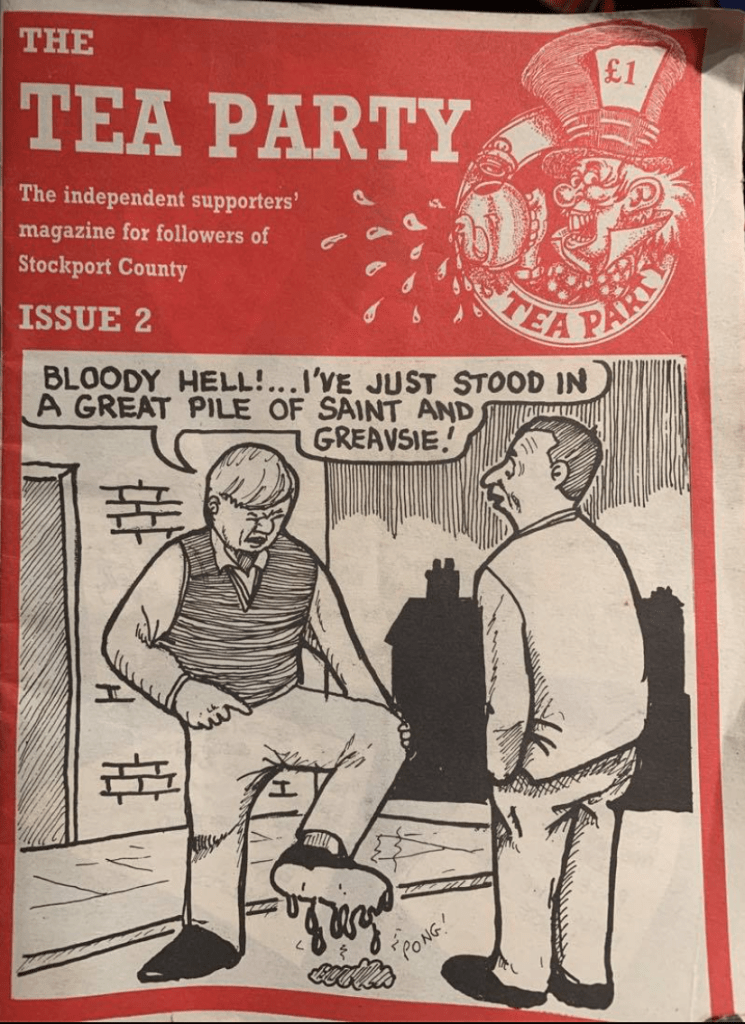
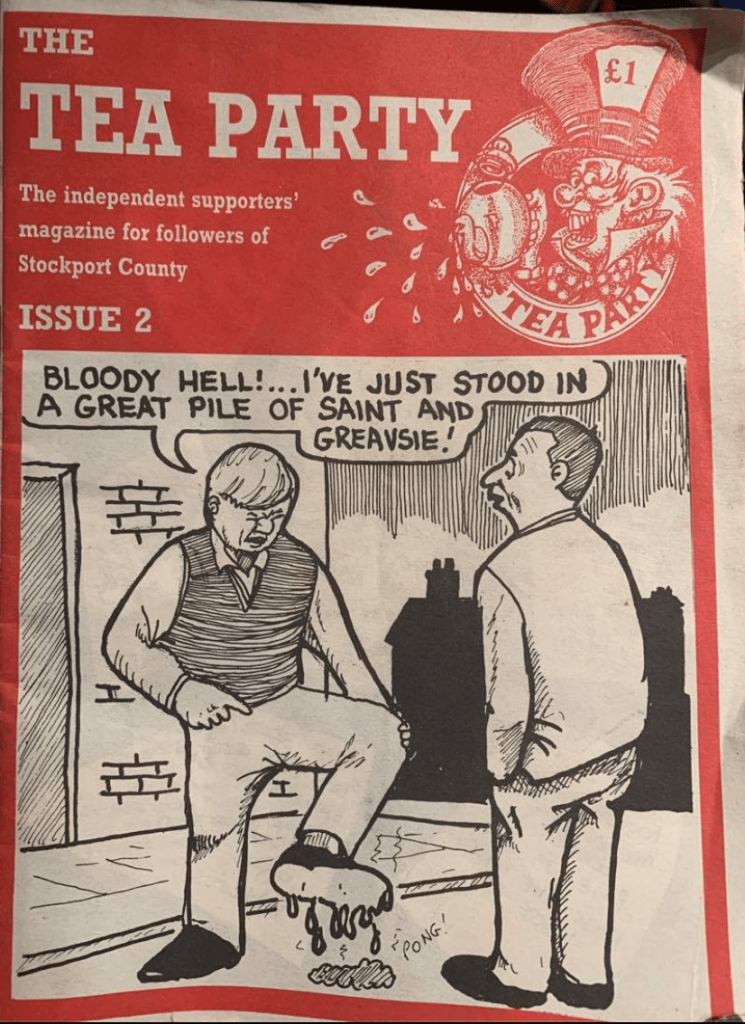
Contextual Research | The Tea Party (Zine)

In recent weeks we have been encouraged to start looking at the subject of zines and I was intrigued by them as my most pertinent memory of them is a zine produced in the 1990’s for supporters of Stockport County Football Club. as a small child I have vivd memories of a long haired hippy type middle aged male selling the Tea Party outside the turnstile at home matches. Having done some searching and asking I managed to get hold of a copy in order to find more about the content and the rhetoric that it promoted.

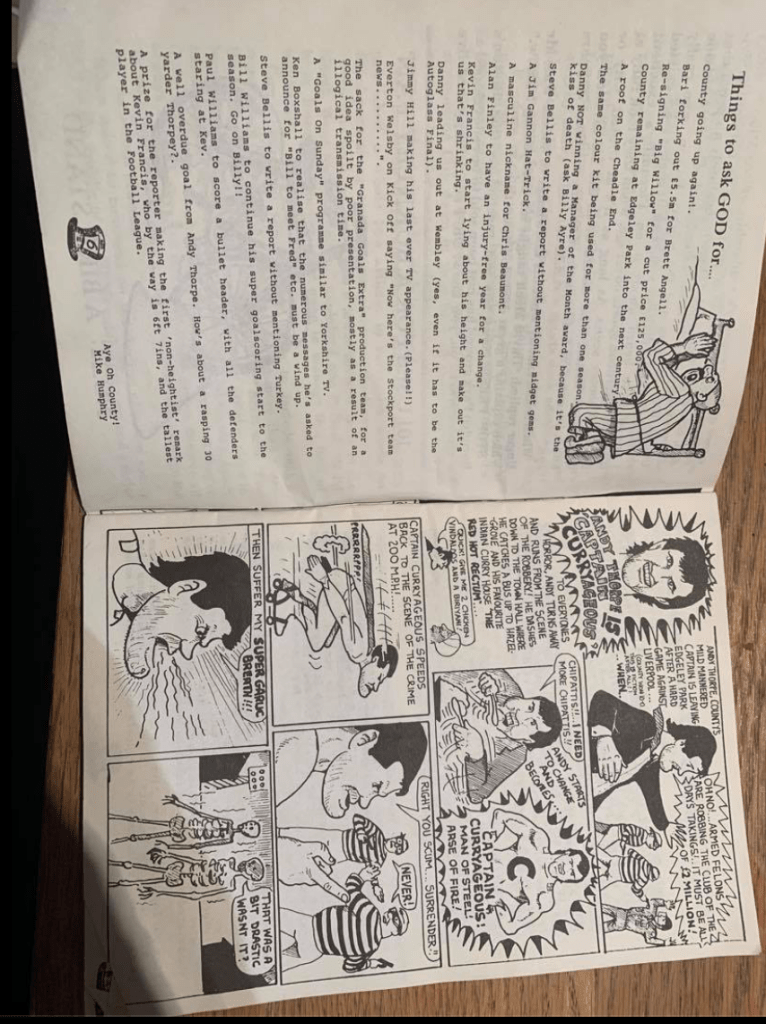
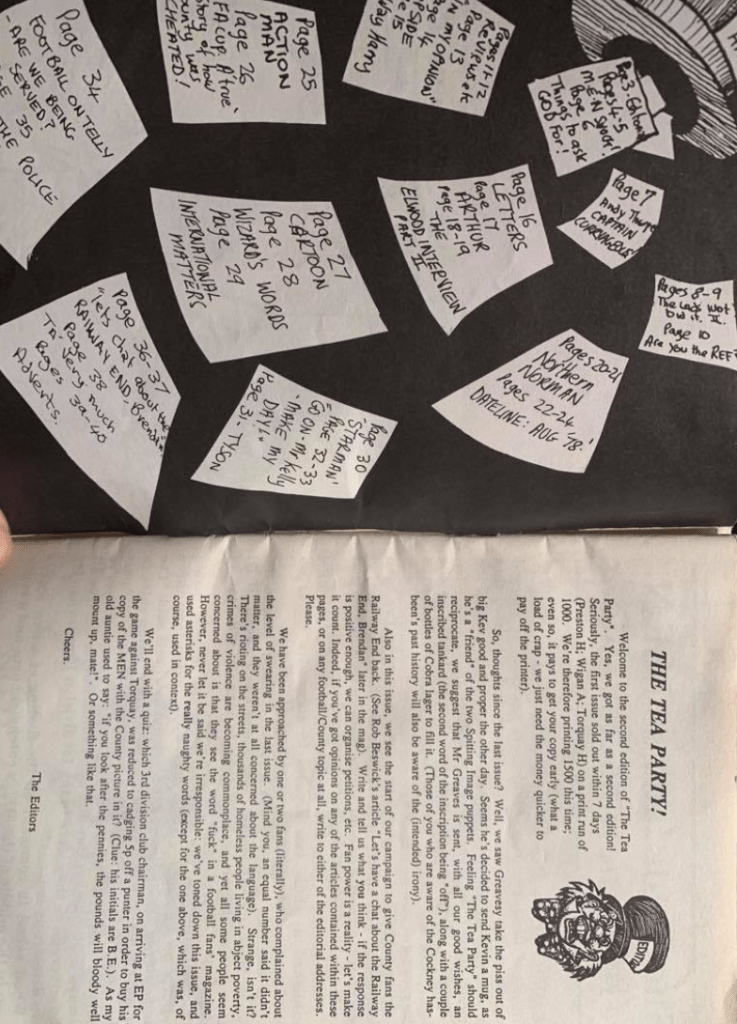
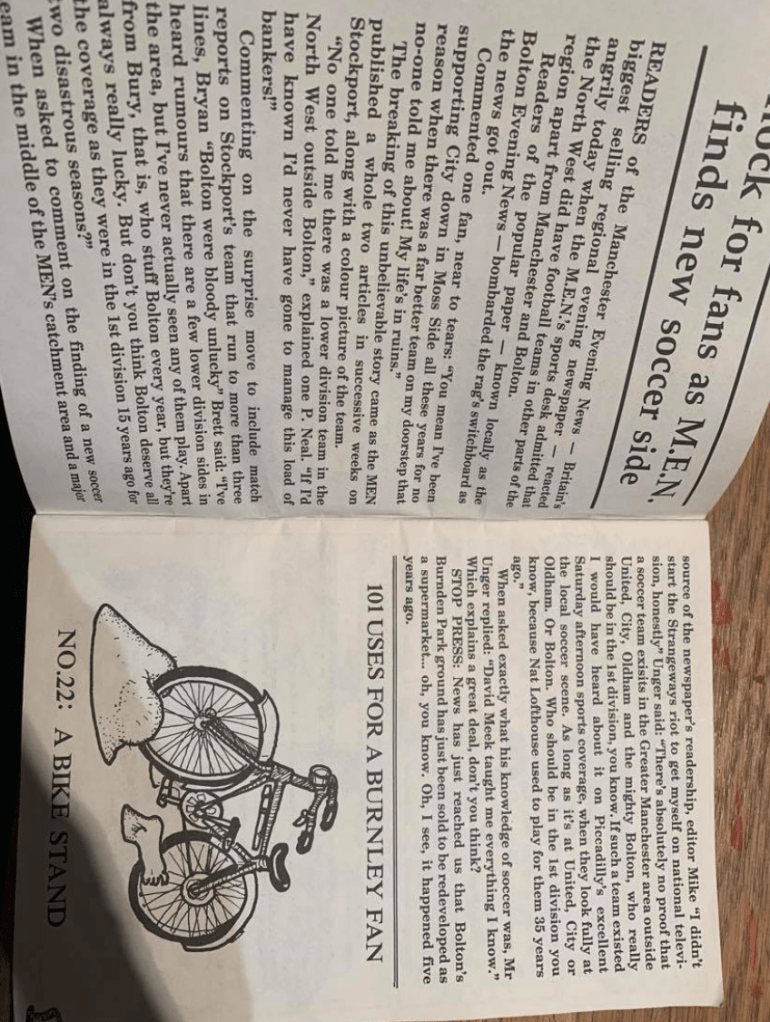
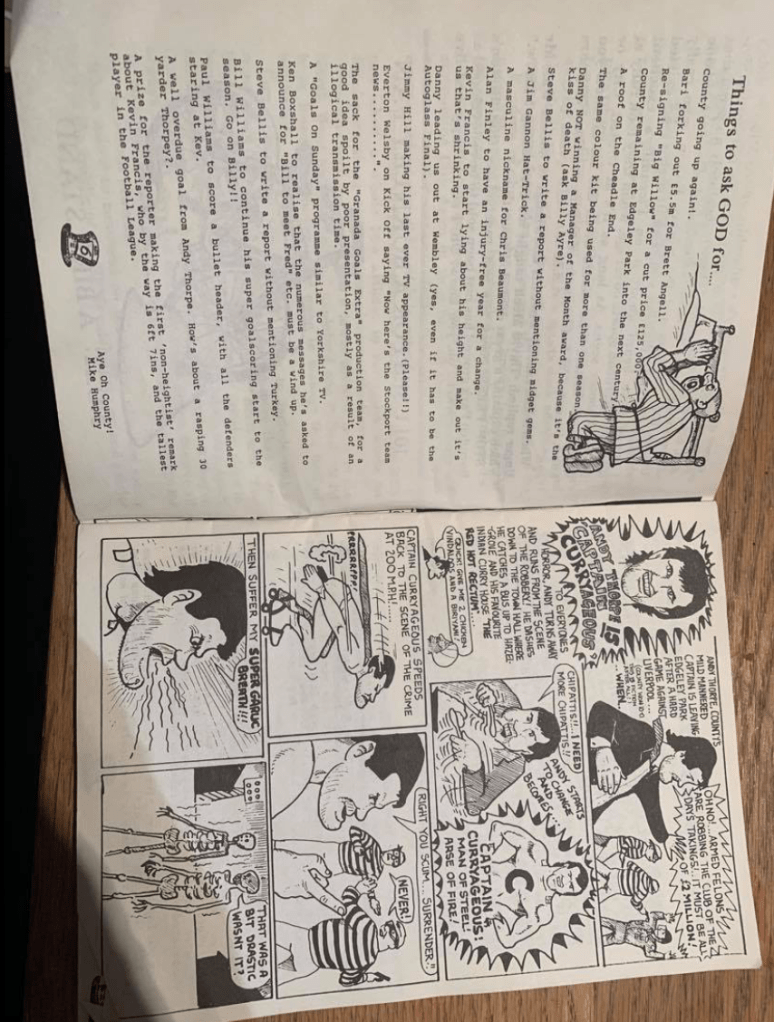
On first reflection, the content of the zine is a type of social commentary on issues surrounding the town of Stockport and its football club. To say that this product would raise a few eyebrows in present day is an understatement. The layout itself conforms to many of the hallmarks of a classic, self published zine. Pink in colour with a secondary colour red, the zine appears to be low value in its production values however in terms of the content it is clear that the producers are passionate about the football club. Around 50 pages, the Tea Party is heavy on written content which verbally attacks rival football clubs in addition to the local media such as the Manchester Evening News (MEN) for not having enough content about the club and choosing to focus on the two Manchester football clubs in addition to Bolton Wanderers.

The main visceral aspects of the zine come in the form of comic strips and drawn illustrations which many place the players at the time in funny or offensive stories at the expense of other football clubs. One of the comic strips is about a Police horse who describes how he like to treat football fans by kicking them pensioners and attacking the younger fans in order to keep them in line.

In an ideological sense, the Tea Party is highly activist against any form of authority in addition to attacking the mainstream media. One would assume that its audience is white working class males as some of the content is comparable to a poor tabloid newspaper. Although quite funny in one respect, I don’t think it could exist in its present for today.

The Tea Party | Front Cover

Shoot | Portraits Using Flash

The intent with this shoot was experiment with portrait photography at a junior football club in Manchester. With the issue of spectators at football still being phorbidden. The impact on my project has been significant and severely limited the ability to make work which encompasses a human presence. Having recently watched the lecture with Michelle Sank, I wanted to experiment with using an on camera flash as a fill light. On this occation I felt that some of the results were adequate however the flash alone wasn’t enough to overpower the the hard light subsequently failing to eliminate shadows on the face. I tried to encounter this by experimenting with shooting with and against the light.

Figure 1 Andrew Findlay

Figure 1 is an example of an image where I used I utilised the on camera flash. The hard light is illustrated by shadows and is coming from right to left. The primary subject is placed in the middle of the frame with the secondary subject to the left. The secondary image provides a form of conflict due to the red shirt he is wearing. I think this is effective as the child is set against the blue container which I felt was an interesting contrast. In using he flash I was able to level the light on the skin tones to some extent without eliminating them all. the flash was also effective in creating some separation between the head of the central subject and the tree in the background. In conclusion, I am quite pleased with the left side of the image and feel that the range of objects provide multiple layers of interest. The right side of the image I felt is disappointing and I would have liked to encompass a third human presence.

The football kit and the the presence of alternative footwear may allude to a reading of an activity due to be taking place. The clothes he is wearing may connote a Father finishing work in order to take his Son to football training.

Culler, J (1982) Suggests ‘Reading a poem is a quest for unity, and unity is achieved or perceived only when the reader abandons the apparent referential or representational meaning of the discourse and grasps the unifying feature of factor that the various signs of the poem express by indirection’.

In relation to the Culler statement I feel that there are unifying factors such as the work clothes of the central figure, unified with the replacement footwear and the football kit worn by the young boy. However the idea that these signs are expressed by indirection is a source contention. I feel that this is a more complex image than my previous work but with complexity comes further opportunity to fail. I consider this image neither a failure or a victory. The image encompasses elements that I am drawn, there are elements I’m not overly impressed with.

Having addressed the composition of the photograph the next relevant element is the colour of the image. The first relevant observation is the vibrancy of the blue and greens present. They are distributed relatively evenly however they are dominated by the red in the image. I understand that red is a colour that often has the power to dominate an image and requires careful consideration. In this case I feel that it does compete with the white shirt worn by the central figure however I feel that the illumination from the sunlight on the white shirt enhances the power of the central figure. The muted, rich blue of the container provides an interesting frame for the secondary human figure and may serve to enhance the vibrance of the red. A colour I often encounter within my football project is the colour green. As Szarkowski comments in Eggleston regarding the difference of the colour blue and the sky. I feel that I often struggle to work with the colour green and grass.

Figure 2: Andrew Findlay

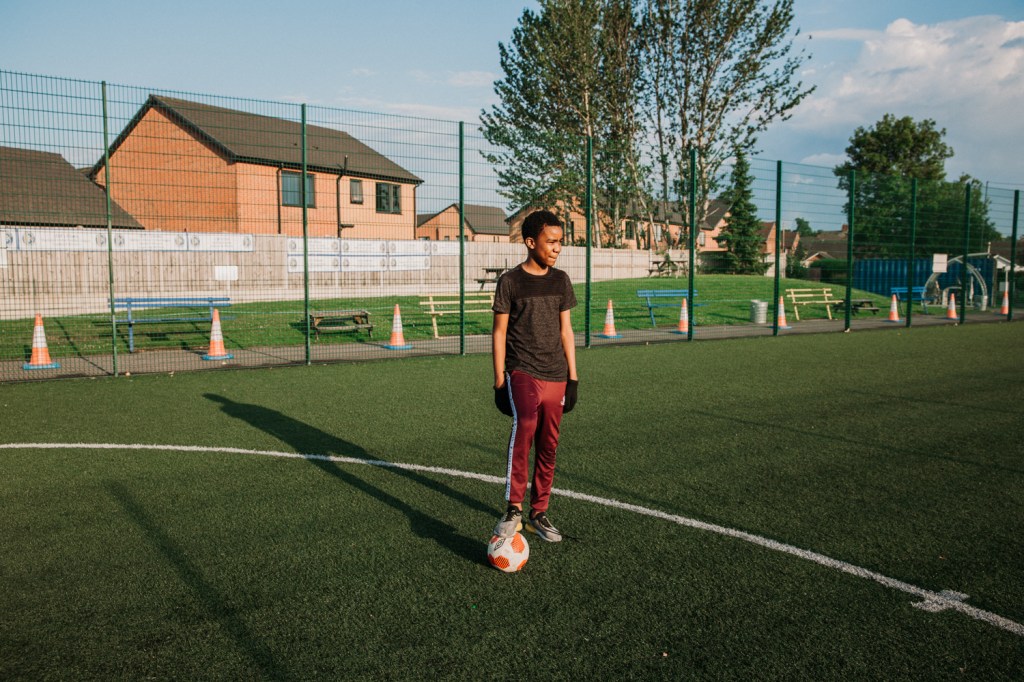
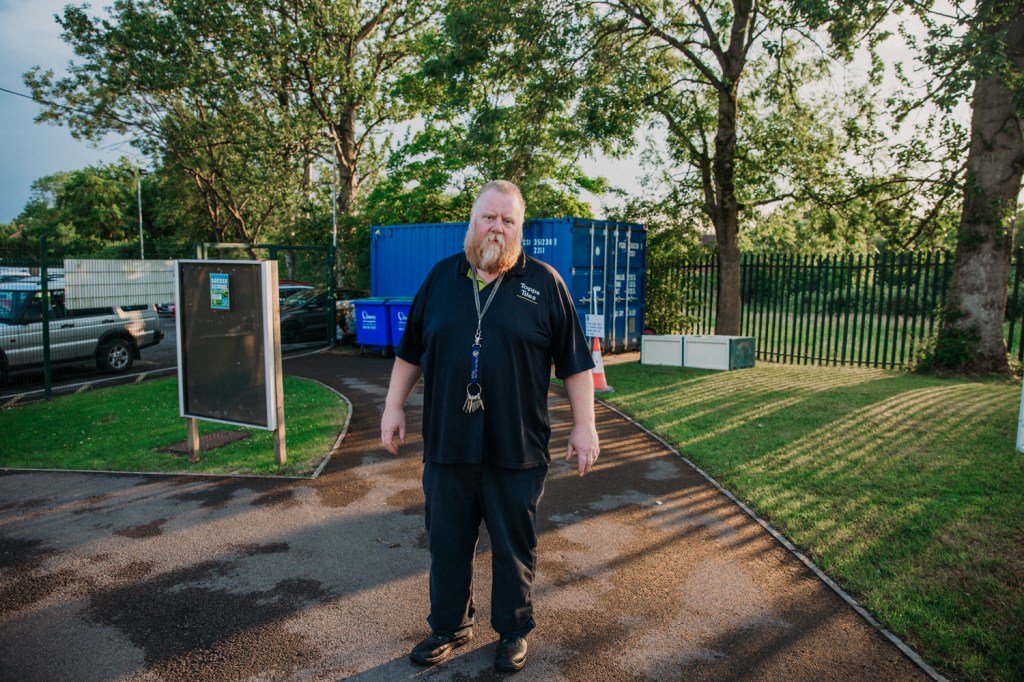
Figure 2 is an image I am unsure of the success. Shot at a wide focal length of around 24mm. The context of the image is present and layered quite nicely, the full length of the shadow is present which I am pleased and the social housing in the background suggest an area of regeneration. Regarding the subject ‘Danny’. He was doing some extra training alone while while he was waiting for his Father to pick him up from the adjacent car park. He doesn’t look like he’s dressed to play football, his lack of equipment may suggest cultural differences as the location of the football club covers an area of a predominantly white working class community (Reddish). With the neighbouring area (Gorton) Manchester being very diverse with a large community of African heritage.

Figure 3: Andrew Findlay

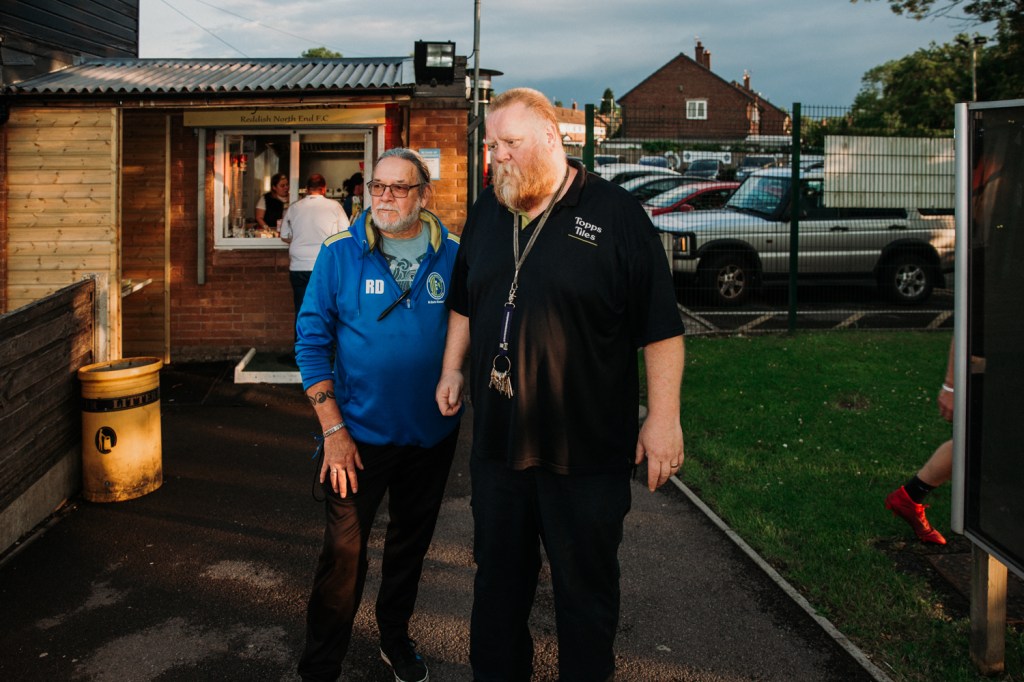
In addressing figure 3. I felt that for many reasons which I won’t explain, this was my strongest photograph within this collection. In short, I am pleased with the effect of the flash and the luminosity created. However I feel compelled to address the major weakness within this photograph which is the vantage point. The vantage point includes serves to ensure that a pair of street cones around the head of the subject cause a major distraction within the image. The result, is the breaking of one of the central rules of portrait photography. I am inclined to be disappointed with this flaw as it is very much rule one of this type of work. However, in defence of this to myself, I felt that I was concentrating on other aspects such as the flash and bouncing it off the perspex material above that I neglected the main focal point of the image.

Webb, A and Norris Webb, R (2014) cite Arbus ‘It’s important to take bad pictures. It’s the bad ones that have to do with what you’ve never done before. They can make you recognise something you hadn’t seen in a way that you will make you recognise it when you see it again’

Comments such as Arbus perfectly illustrate my reflection regarding figure 3. I will attend this venue again and look to re photograph a similar scene with the due considerations noted in this reflection. As I have good access to this venue I will use this space as to experiment further when working with a human presence. I am known within this community therefore suspicion of me will not be as bad and allow further practice. The possibility of the production of a zine may be an opportunity in this sense.

Figure 4: Andrew Findlay
Figure 5: Andrew Findlay
Figure 6: Andrew Findlay
Figure 7 | Andrew Findlay
Figure 8 | Andrew Findlay
Figure 9 | Andrew Findlay

In relation to figure 9. Webb, A and Webb, R (2014, p67) make a relevant observation when they state regarding the edge of a photograph ‘Where the frame cuts often creates much of the tension in an image-especially in small format photography.’ I am drawn to the figure of a red football boot, partly illuminated by the natural light. This serves to provide anchorage to the image by placing it within a community football context. The logo on the subject on the left, further illustrates this anchorage however a little more obvious. These two elements in their symbiotic relationship I feel may have potential of a poetic nature.

Culler, J (1982) Culler, The Persuit of Signs, Routledge, London.

Eggleston, W. (2002) William Eggleston’s Guide. New York, The Museum of Modern Art.

Webb, A and Webb, R (2014) On Street Photography and the Poetic Image. Aperture, New York

Szarkowski in Eggleston 2002

Over the course of the last module I became aware of the work of Eggleston and was seduced and intrigued by his motivations. At times, his work overstretched my creative intelligence sometimes enjoying his photographs but unable to pontificate as to why I was drawn to them. This is where studying at MA level has really opened up a broader understanding of the world we see around. Being able to access an understanding of the vernacular world, finding enjoyment from it as a starting point, to developing a critical understanding. 

In terms of training my personal gaze, Eggleston has been very important in furthering the way I see photographic opportunities. Upon reviewing William Eggleston’s Guide, I wasn’t able to jump in and immediately understand the work and be able to comment on it in with immediacy. Having had a quick review of the photographs contained within, I was able to familliarise my self with his work and have some of the photographs in the mind so that I could contemplate. I also engaged with a brief reading of the Szarkowski essay included within the book. 

Over the months I have built some knowledge of Szarkowski’s writings, and understand that he is a type of gatekeeper of the art photography world. I find his writings engaging and able to engage with, which is something I sometimes find difficult. Reading his essay within the book I had an idea of what to expect but I wanted to choose my time of reading in order to prepare myself appropriately. 

Before engaging and contemplating the work contained within this book, Szarkowski makes a number of useful comments regarding relevant themes helpful in in the aid of contemplation. As a starting point, Szarkowski in Eggleston (2002, p 6) states… 

‘If we see pictures clearly as photographs, we will perhaps also see or sense, something of their other, more private wilful, and anarchic meanings’.

In considering this point, I am led to think about the intuition of the photographer in both my own sense in addition to understanding the work of others. I photograph the world as I see it. As a result of study at MA level I have no doubt that I see the world with a different perspective. That perspective is my own, and is shifting and evolving with my education. It is interesting to look back at my past work, whilst studying the MA and before studying the MA. In doing this I see a plethora of photographs, some nieve, some horrendous choices and some creative accidents, the occasional photograph that I am proud of. On reflection of this, I feel that the important lesson here is to understand the unique way that an individual looks at the world and be able to, and have the confidence to recognise work that represents my creative choices at their most powerful and moving as opposed to chasing ideas as dangerous as the pictorial.

With regards to the work I am producing at present, I feel that I am breaking new ground in the selection of when to fire the shutter. However having not been as successful as I would have liked on the last module, the knock in confidence serves to both create indecision while providing a drive to improve. Ultimately, I am working towards the justification by education and reflection on as deeper level as I am able to access. Photography offers infinate opportunities to reflect one’s voice. The pursuit of informed choices which represent maturity as opposed to sophistication is my shifting intention towards the future. 

Reflecting a private gaze which reflects the effort I invest. The destination as Szarkowski  (2002, p7) puts it ’The photographer hopes, in brief. To discover a tension so exact that it is peace’.  in doing this Szarkowski further states ‘photographers of exceptional talent learned to use the entire plate with boldness’.  Szarkowskis comments in relation to one’s approach are relevant to my practice especially at this point in the face of dissapointment of my own recent progress. Serving as motivation to keep trying, keep progressing and keep failing 95% of the time in order to be able to seek as much development as possible and make the images that reflect the intelligence of my creative capabilities. In search of this I will endeavour to ensure that I am being bold, I am using my research and make the reflective cycle work, the end point being the photograph. 

In  relation to being bold, and considering what it is to be bold within my own work, I use the images of Eggleston as a beacon of ‘being bold’. This idea doesn’t belong to Eggleston alone. Rather a blueprint for the the work that I am attemting to create.

When reviewing the work of Alex Webb, I see the boldness, not just in the vibrance and use of colour or the busy compositions. Rather the confidence to accept all of the variables but make work as a result of them. The difficulties of working with composition and colour I will address later but those such as Eggleston and Webb at present are a metaphor for where I want to be in a philosophical sense. Not simply trying to copying but being bold with choices. Stepping outside of my own vernacular and limiting fear of failure. 

Sometimes in seminars I would present images in black and white and my tutor Michelle would challenge me to explain why I had made such choices. In response I would often offer little response which is no doubt due to my lack of knowledge in this area. Having researched the work of Webb and Eggleston I am building a knowledge that black and white photography often revolves around the power of the composition or form as opposed to the colour photography where form and colour Pallet are considered seperately. I have found this quite difficult in some respects of my work thus far. The most obvious problem for me is dealing with the sky. Understanding the difference between the colour blue, and the sky Szarkowski (2002, p9) is a relevant issue as many of my shoots have yielded results with blown out skies, this I feel to an extent is a result of the dreary Manchester weather in the winter months when the majority of my work was composed. However I have had limited success when attempting to make work which echoes that of Hans Van Der Meer, shooting at a higher aperture whilst using floodlights to illuminate what would be the darker areas of the photograph. Using this method and exposing the camera for the sky opened up the texture in the sky and allowing one to add the colour of the sky in addition to the texture, which resulted in encompassing a richer colour and more interesting texture with the result of filling the edges of the frame, layering the the image with further interest.

When considering the composition in the work of Eggleston Szarkowski (2002) comments ‘the design of most of his pictures seemed radiate from a central circular core’. This may sound like a fairly simple observation with most amateur photographers aware of such basic rules however what is interesting to me about this observation is Szarkowski’s use of terminology when he state ‘radiate’. Here the reference refers to the idea of a progressive nature of waves of simulation, waves of semiotic unions leading to a more complexed reading. Having use of the whole frame in order to add veracity. Raising questions, Selecting vantage points to encompass further layers for contemplation. Whether the use of colour, composition or both in union to illustrate the vernacular. Eggleston furthered this approach by alluding to the notion that he bases his compositions on the Confederate flag. An idea that Szarkowski appears to be unsure however the idea is certainly worth considering and being aware of in future shoots and having in mind. The idea that Eggleston’s pictures ‘aren’t concerned with large question as opposed to describing life’ I fees is slightly puzzling as I feel that Eggleston’s work deals with complex issues relating to the vernacular. I understand that Eggleston’s intentions we’re not noble in the sense that he wasn’t dealing with relevant issues such as inequality or poverty. He deals with the everyday, his work is about the private sphere, an idea that reveals as much about his subjects lives and environments as do the intentional imperfections in his work. Alluding to his dislike of the pictorial and the conventional rules.

Eggleston, W. (2002) William Eggleston’s Guide. New York, The Museum of Modern Art.